

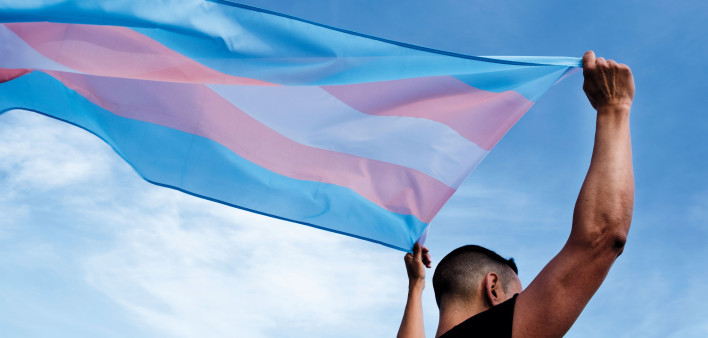
As President Donald Trump’s executive orders threaten to strip away protections for transgender and gender-nonconforming people, a new report by the O’Neill Institute at Georgetown Law urges health care providers and health departments to expand HIV care and improve the health and safety of these populations and offers recommendations on how to do so.
Report authors Jeffrey Crowley, MPH, director of the Center for HIV and Infectious Disease Policy at the O’Neill Institute, and Kirk Grisham, MPH, the center’s program manager, call for broader societal support for transgender and gender expansive people, an umbrella term for nonbinary or gender-nonconforming people.
Trump’s exercise of presidential power “seeks to negate the existence of transgender and gender expansive people,” the authors write, adding that Trump’s executive orders also “seek to remove the promise of fair and equal treatment in federal programs and other areas of civic life for not only members of the LGBTQ community, but also people of color and others.”
The eight-page report is titled “Improving the Health and Safety of Transgender and Gender Expansive People” (you can read a two-page brief here). It includes easy-to-digest “getting to know you” graphs and data about trans and gender expansive people as well as tips on simple actions Americans can take to help improve the lives and health of trans folks.
In the United States, about 1.6 million people identify as transgender, 300,000 of whom are between 13 and 17 years old, according to the report, which uses data from the Williams Institute at the UCLA School of Law, known for its research on sexual orientation and gender identity law and public policy. This means that 0 1.4% of youth and 0.5% of U.S. adults 18 and over identify as transgender.
Transgender and gender expansive people have a higher rate of HIV compared with the rest of the population. In 2021, transgender folks accounted for 2% of new HIV diagnoses. Including all populations, genders and sexualities, about 36,100 people tested HIV positive in 2021. Trans women accounted for 89% of new diagnoses among all trans people, and 78% of those women were Black and Latina.
The report highlights three critical areas in which support for transgender and gender expansive people can be achieved and enumerates actionable steps that can be taken in each area:
RECOGNITION AND RESPECT
Transgender and gender expansive people have been with us throughout history. There are several actions that can better recognize and respect transgender and gender expansive people in society.
- Improve journalistic standards and expand opportunities for transgender and gender expansive artists and other cultural influencers to tell their stories;
- Faith communities need to provide models for embracing transgender and gender expansive people;
- Health care providers need to build the skills to respectfully and sensitively treat all people, including transgender and gender expansive people.
RIGHTS OF ALL PEOPLE
A promise of citizenship is that all people have certain rights. Much of the backlash against transgender and gender expansive people seeks to infringe on these rights.
- Law enforcement, schools, workplaces, and civic institutions need to protect the safety of all people, including transgender and gender expansive people.
- Employers, unions, and recruitment agencies must publicize and enforce nondiscrimination protections in employment.
- Civil society groups need to establish policies that normalize the expectation that transgender and gender expansive people have the same rights as other members.
HIGH-QUALITY HEALTH CARE
Effective HIV prevention and care must be built on a foundation of affirming high-quality care:
- Medical societies, primary care associations and others need to expand the capacity to provide high-quality care consistent with WPATH [World Professional Association for Transgender Health] Standards of Care for Transgender and Gender Diverse People.
- Health providers, researchers and funders of research must expand the capacity to collect SOGI [sexual orientation and gender identity] data while ensuring that privacy and confidentiality can be protected from forced disclosure.
- Health departments and clinical providers and community-based organizations should set goals and monitor progress toward improving HIV prevention and care outcomes for transgender and gender expansive populations.
As the report explains, LGBTQ people often face barriers to health care due to transphobia or HIV-related stigma and discrimination.
What’s more, stigma and discrimination against LGBTQ people contribute to higher levels of unemployment, poverty, homelessness, sex work, depression, other mental health problems, substance use, incarceration and violence—all of which are linked to higher rates of HIV.
“Most people in the U.S. report that they do not yet know anyone who is transgender or gender expansive, yet already two in three favor protecting them from discrimination in jobs, housing and public spaces,” the report reads. “By acknowledging their dignity and place in society, extending them the same basic rights as others enjoy, and ensuring that the health system can offer high-quality health care, transgender and gender expansive people will be given the freedom to contribute fully to society.”
To read more, click #Gender-Affirming Care or #Access to Care. There, you’ll find headlines such as “Trump’s Order on Gender-Affirming Care Escalates Reversal of Trans Rights,” “Death, Chaos, Budget Cuts, Exemptions: Updates on Global HIV Program PEPFAR” and “Activists Protest at U.S. State Department to Restore Global HIV and AIDS Programs.”



Comments
Comments