

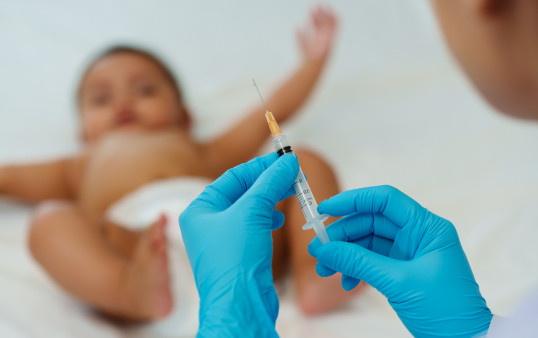
A new Trump administration executive order that reduces and spaces out recommended childhood vaccines is unscientific and dangerous, American Academy of Pediatrics (AAP) leaders said Monday [August 10].
Officials at an event announcing the order repeatedly suggested a link between vaccines and autism, though it was not mentioned in the order. Discouraging vaccination based on these false claims would leave children vulnerable to preventable diseases.
“There is no new evidence to justify significant changes to childhood immunization guidance,” AAP President Andrew D. Racine, MD, PhD, FAAP, said in a statement. “Dozens of studies involving millions of people show there is no link between vaccines and autism, and yet federal leaders continue to promote this outdated, disproven idea to scare families. Today’s executive order will do nothing to support families of children with autism or advance understanding of the condition.”
President Donald J. Trump’s executive order recommends children get vaccines to protect them from 11 diseases, down from 18. The recommendations mirror those a federal judge struck down in March but administration officials said they hope states will implement them.
“The only thing I can see is going to happen as a result of the announcement today is the injection of greater amounts of uncertainty and fear and confusion where there doesn’t need to be any,” Dr. Racine said in a press conference.
Under the executive order, all children are recommended to be vaccinated against measles, mumps, rubella, diphtheria, tetanus, pertussis, polio, Haemophilus influenzae type B, pneumococcal disease, HPV [human papillomavirus] and varicella [chicken pox].
Immunizations recommended by the executive order for children considered to be at high-risk are respiratory syncytial virus monoclonal antibodies, hepatitis A, hepatitis B, meningococcal B, meningococcal ACWY and dengue. Children also could get hepatitis A, hepatitis B, rotavirus, meningococcal disease, flu and COVID-19 vaccines based on shared clinical decision-making.
The AAP continues to recommend vaccines to protect against all 18 diseases in its 2026 immunization schedule.
Trump’s executive order also calls for administering measles, mumps, rubella vaccine as separate, single-disease shots and administering all childhood immunizations at separate medical visits “to the maximum extent feasible.”
Experts noted these changes would not be feasible or safe and that they come as measles cases reach a 35-year high. Individual vaccines for measles, mumps and rubella have not been available in the United States since they were phased out of production in 2009.
"As measles cases reach a 35-year high in the U.S. and with cold and flu season quickly approaching, today’s executive order on vaccines is not only disheartening but dangerous,” Dr. Racine said. “Instead of ensuring every family can access life-saving vaccines for measles, influenza, RSV and more, federal leaders are once again spreading misleading claims.”
The executive order also said states have an obligation to provide religious and medical exemptions from child and adolescent immunization requirements. In addition, it calls for the Task Force on Safer Childhood Vaccines to offer options to administer single rather than combination vaccines, assess ideal timing and sequencing of vaccines, develop additional alternative adjuvants to aluminum and improve safety monitoring.
In addition to billing the order as a means to reducing autism, Trump referred to European countries giving children fewer vaccines. However, many give a similar number to the U.S. and others have significantly different populations, disease burdens and health care systems.
“Vaccine recommendations from the American Academy of Pediatrics are tailored to the health of children living in the United States and are based on decades of research and systematic tracking of real-world experiences,” Dr. Racine said. “Pediatricians recommend children receive certain vaccines at specific ages based on when children’s immune systems will respond best and when they are most vulnerable to certain diseases.”
He encouraged families to talk to their pediatricians if they have questions about the vaccines the AAP recommends for their children.
This news release was published by the American Academy of Pediatrics on August 11, 2026.



Comments
Comments