


COVID-19 no longer ranks among the Top 10 causes of death in the United States, and the overall death rate in 2024 has fallen to its lowest level since the start of the pandemic, according to a new report from the Centers for Disease Control and Prevention (CDC).
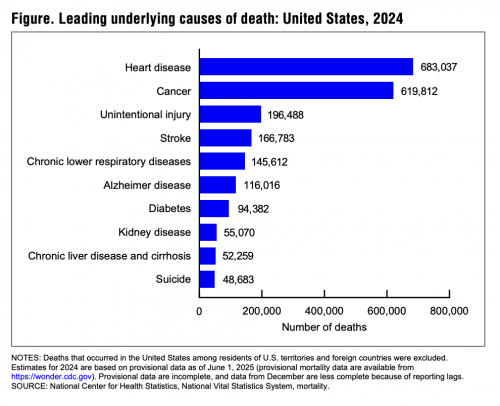
The latest provisional data do not support Health Secretary Robert F. Kennedy Jr’s claim that America is the unhealthiest it’s ever been, but he’s correct that chronic diseases are the nation’s major killers. Heart disease topped the list, at 683,037 deaths, followed by cancer, at 619, 812 deaths. Both are higher than last year’s numbers.
CDC
A total of 3,072,039 deaths occurred in the United States in 2024, according to the report. The overall death rate of 722.0 per 100,000 people was about 4% lower than the 2023 rate—the third annual decline in a row. As expected, men had a higher death rate than women (844.8 versus 613.5 per 100,000). Mortality decreased for most age groups and all racial/ethnic groups, but Black people continue to have the highest death rate (884.0 per 100,000).
COVID—No. 3 in 2020 and No. 10 last year—no longer ranks among the Top 10, but it still accounted for more than 47,500 deaths in 2024, according to the CDC. With COVID falling off the list, no infectious diseases are included in the Top 10. HIV/AIDS, which was once a leading cause of death among young adults, accounted for 4,496 deaths in 2023, according to CDC data. In the era of effective antiretroviral treatment, the causes of death for people with HIV are now similar to those for the population at large.
Stroke was the fourth leading cause in 2024, at 166,783 deaths. When combined with heart disease, cardiovascular causes are responsible for an overwhelming share of U.S. mortality. Despite improvements in early detection and treatment, cancer remains a leading killer. Alzheimer’s disease ranks at No. 6, with 116,016 deaths, reflecting the aging of the American population.
Chronic liver disease and cirrhosis together rank at No. 9, responsible for 52,259 deaths. Over time, chronic hepatitis B, hepatitis C, metabolic dysfunction-associated steatotic liver disease (MASLD) and heavy alcohol use can lead to complications including cirrhosis and liver cancer. Now that widespread vaccination can prevent hepatitis B and hepatitis C can be easily cured with antivirals, fatty liver disease has become a leading cause of serious liver-related outcomes in the U.S. and worldwide. Diabetes, one of the metabolic conditions associated with fatty liver disease, came in at No. 7, accounting for 94,382 deaths.
Unintentional injuries, including accidents and drug overdoses, were responsible for 196,488 deaths in 2024. While overdose deaths declined by nearly 24% last year, they still accounted for some 87,000 deaths between October 2023 and September 2024, according to CDC data. Suicide accounted for 48,683 deaths.
“Provisional death estimates can give researchers and policymakers an early signal about shifts in mortality trends and provide actionable information sooner than final mortality data,” the report authors wrote. “These data can inform public health policies and interventions aimed at reducing mortality.”
As the latest mortality data show, a large proportion of deaths can be prevented with lifestyle changes, such as smoking cessation, weight loss and exercise, vaccination (for hepatitis B and human papillomavirus, which causes several types of cancer) and management of risk factors such as high blood pressure and elevated blood sugar. But contrary to RFK, Jr’s stated goal of reducing chronic diseases, the Trump administration’s drastic cuts to Medicaid, health services and medical research could leave Americans sicker and more likely to die.




Comments
Comments