


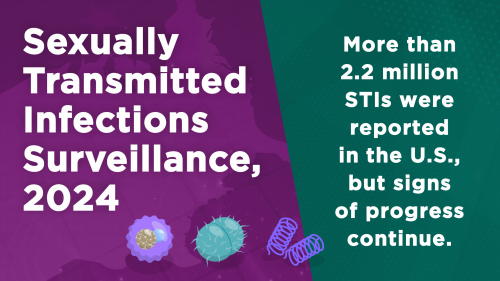
Sexually transmitted infections (STIs) decreased by nearly 9% overall last year, according to provisional data released last week by the Centers for Disease Control and Prevention (CDC) in its Sexually Transmitted Infections Surveillance, 2024 report. But the news is not uniformly good, as congenital syphilis among newborns continues to rise.
CDC
The news comes at a time when federal funding for STI, sexual health and women’s health services is facing steep cuts, and advocates fear that recent progress could be lost.
“While the STI epidemic may be turning a corner, we must accelerate progress and stop its most tragic consequences,” Bradley Stoner, MD, PhD, director of the CDC’s Division of STD Prevention, said in a news release. “About one in five people in the United States have an STI, affecting millions of Americans and thousands of babies each year. We need to continue our prevention efforts wholeheartedly at federal, state and local levels.”
Taken together, the three major reportable bacterial STIs—chlamydia, gonorrhea and syphilis—decreased by 8.5% among adolescents and adults, the third consecutive annual overall decline. Nonetheless, the total STI burden remains substantial, with more than 2.2 million cases reported in 2024. In contrast, syphilis among infants rose yet again.
According to the report:
- Chlamydia cases fell by 8.0%, to just over 1.5 million cases (approximately 944,000 among women and 564,000 among men), the second consecutive annual decline.
- Gonorrhea cases declined by 9.6%, the third consecutive annual drop. Unlike chlamydia, gonorrhea was more common among men (approximately 342,000 cases) compared with women (approximately 199,000 cases).
- Primary and secondary syphilis—the most infectious stages—declined by 21.7%, down for a second straight year. Men accounted for more than twice as many cases as women (approximately 29,600 versus 11,900, respectively).
- Late-stage or unknown-duration syphilis fell by 1.5%. This was also more common among men than women (approximately 57,600 versus 39,500 cases).
- Congenital syphilis rose by 1.6%, reaching approximately 3,900 cases. This was the twelfth annual increase in a row, but it was much lower than the double-digit jumps seen in some prior years.
STI case numbers can fluctuate from year to year, and the COVID-19 pandemic threw a wrench into testing and reporting. Longer-term trends show a substantial upswing in recent decades, with a 13% overall increase from 2015 to 2024, largely driven by a steep rise in chlamydia.
Recent data, however, suggest that STI trends among adults may have turned around. Public health efforts likely contributed to the decline, including more self-testing and the adoption of doxyPEP by gay and bisexual men and transgender women, groups with disproportionately high STI rates. Taking a single dose of the antibiotic doxycycline within 72 hours after sex substantially lowers the risk of chlamydia and syphilis, with a more modest decline for gonorrhea.
Yet the picture remains concerning for congenital syphilis. The nearly 4,000 cases reported in 2024 represent an almost 700% increase from the 495 cases reported in 2015, though the curve has recently flattened. Acquired during gestation or delivery, congenital syphilis can cause miscarriage, premature birth or stillbirth and can lead to serious complications for the baby, including neurological problems, bone and organ deformities, blindness and deafness.
The CDC expects the 2024 STI data to be finalized in 2026. While case counts will likely change slightly, the agency does not anticipate substantial revisions to the rates and national trends in the provisional report.
The full report for 2024 should provide more details about geographic and demographic disparities that are not apparent in the aggregate national data. As previous reports have shown, STI rates differ substantially according to sex, age, race/ethnicity, sexual orientation, HIV status and region of the country, with young adults, Black people, Native Americans, men who have sex with men and people in the South having higher prevalence.
“The latest CDC data is a hopeful sign that the nation is making progress on an out-of-control STI epidemic, but we have far more work to do before Americans can feel sufficiently protected,” Elizabeth Finley, interim executive director of the National Coalition of STD Directors, said in a statement. “The continued rise in congenital syphilis is a distressing indication that we are not doing enough to protect pregnant women and newborns from the deadly and preventable consequences of syphilis transmission during pregnancy.”
“We call on the Trump administration to make sure states and cities can win this fight by giving them the resources, information, effective workforce, and modernized systems they need to protect every American, and particularly our most vulnerable infants,” she added.
Click here to read the CDC’s Sexually Transmitted Infections Surveillance, 2024 provisional report.
Click here for more news about sexually transmitted infections.




Comments
Comments