

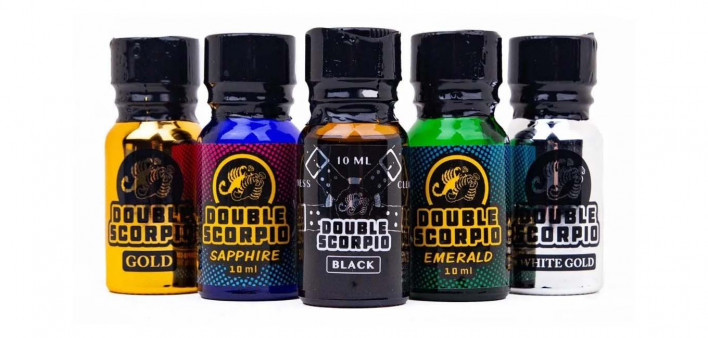
At least one major seller of poppers has been raided by the Food and Drug Administration (FDA) and other brands shut down their websites and social media last week, according to a report from Fast Company. Some suspect the directive may have come from newly appointed health secretary Robert F. Kennedy Jr., who has suggested that poppers cause AIDS.
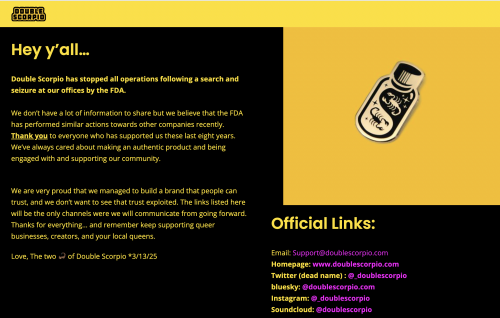
Double Scorpio
“Double Scorpio has stopped all operations following a search and seizure at our offices by FDA,” the Austin-based company said in a statement released March 13. “We don’t have a lot of information to share but we believe the FDA has performed similar actions towards other companies recently.”
Pac-West Distributing, one maker of the Rush brand of poppers, replaced its website with just a logo, and it has shut down its phone line, Fast Company reported. Another Rush producer, AFAB Industrial, has also gone silent.
Poppers, or nitrite inhalants, are vasodilators that expand blood vessels, relax muscles and cause a rush of blood to the brain. Many gay men use poppers to make anal sex easier and more pleasurable. Poppers were a common feature of the disco and bathhouse scenes of the late 1970s and early 1980s, and they had a resurgence of popularity beyond the gay community during the rave era.
The FDA has long discouraged the use of poppers. “Make no mistake, ingesting or inhaling poppers seriously jeopardizes your health,” Judy McMeekin, PharmD, the FDA’s former associate commissioner for regulatory affairs, warned in a 2021 advisory. “These chemicals can be caustic and damage the skin or other tissues they come in contact with, cause difficulty breathing, extreme drops in blood pressure, decreases in blood oxygen levels, seizures, heart arrhythmia, coma, and death. Do not ingest or inhale under any circumstances.”
Yet poppers have existed in a legal gray area. Amyl nitrite is a prescription drug, and butyl nitrite is banned in the United States, but manufacturers make a host of chemically similar products in an effort to stay a step ahead of the law. They are easily purchased online and at sex shops, smoke shops and convenience stores, often sold as room deodorizer, leather cleaner or nail polish remover.
The recent developments could signal that the FDA intends to crack down, but so far, the agency has offered no specifics. “As a matter of policy, the FDA does not comment on possible criminal investigations,” an agency spokesperson said in a statement.
Poppers and AIDS
The FDA is one of several federal health agencies under RFK Jr.’s purview as head of the Department of Health and Human Services. He has a history of AIDS skepticism, although his current position is hard to fathom because his statements have been all over the map.
“There are much better candidates than HIV for what causes AIDS,” Kennedy told an interviewer in a June 2023 article in New York magazine. In his 2021 book, The Real Anthony Fauci: Bill Gates, Big Pharma, and the Global War on Democracy and Public Health, he favorably cited University of California Berkeley molecular biologist Peter Duesberg, PhD, who attributes AIDS to environmental and lifestyle factors, including poppers and other recreational drugs.
But the hypothesis that poppers cause AIDS didn’t start out as a homophobic conspiracy theory.
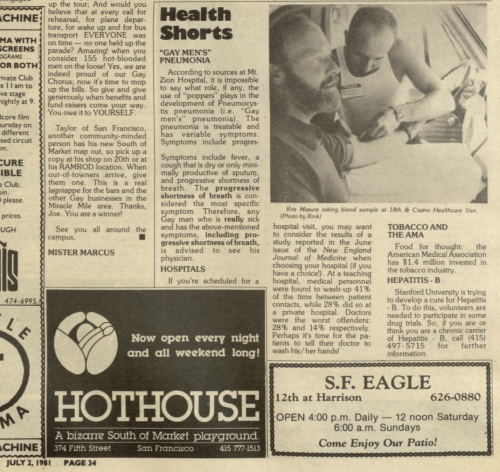
First mention of AIDS in the Bay Area Reporter, July 2, 1981Bay Area Reporter
Gay activists—including the late renowned San Francisco advocate Hank Wilson—and clinicians who cared for gay and bi men were among the first to suggest a link in the early 1980s when they noticed that men coming down with unusual pneumonia and cancers frequently used poppers. In fact, the first mention of AIDS in the Bay Area Reporter (the oldest continuously published LGBT newspaper in the United States) was in a July 2, 1981, Health Shorts column about “gay men’s pneumonia,” potentially linked to poppers. At the time, the community was desperately grasping for risk factors, looking for anything they could do or avoid to keep themselves safe.
The purported link between poppers and AIDS is a classic case of the maxim that “correlation does not imply causation.” Gay men who have lots of sex often use poppers, and this was the main group that succumbed to AIDS in those early years, but that does not mean that poppers themselves cause the disease.
Some studies have found that inhaled nitrites have a detrimental effect on immune function, and they have been associated with certain cancers in mice and in humans. But in 1983 and 1984, researchers in France and the United States independently identified HIV, or human immunodeficiency virus, as the cause of AIDS. Within a few years, scientists had shown that antiretroviral drugs that disable the virus can halt disease progression and allow the immune system to recover.
Today, most people recognize that HIV causes AIDS, but that hasn’t stopped the myth that poppers play a role from periodically rearing its head. Just last year, for example, podcaster Joe Rogan and his guest Bret Weinstein suggested that “party drugs” are an important risk factor.
But even the most cursory overview of the epidemic shows that people who have never been part of the gay party scene still get HIV.
“Hey, RFK, I never did poppers!” Rebecca Denison, a longtime advocate who was diagnosed with HIV in 1990, declared during her rousing opening talk last week at the Conference on Retroviruses and Opportunistic Infections (CROI 2025). Nor did the millions of men and women who have died of AIDS or are living with HIV in Africa.
With Kennedy’s ascendance to the head of the federal health hierarchy, people with HIV, LGBTQ people and their allies are once again called upon to speak up for science.



1 Comment
1 Comment