

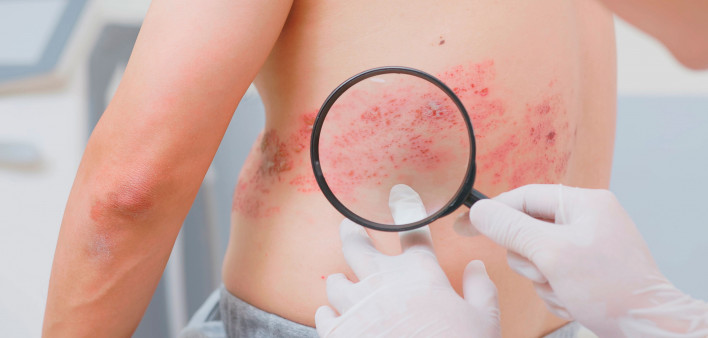
People living with HIV are about twice as likely as their HIV-negative peers to develop herpes zoster—better known as shingles—but vaccination can close the gap, according to a Canadian study published in the Journal of Infectious Diseases.
Shingles is a painful rash caused by varicella-zoster virus (VZV), which also causes chickenpox. Like other viruses in the herpes family, VZV causes lifelong infection. Before the advent of chickenpox immunization in the 1990s, most people acquired VZV during childhood. After recovery, the virus establishes latent infection in nerves and can reactivate later in life to cause shingles.
About one in three unvaccinated adults will develop shingles during their lifetime, according to the Centers for Disease Control and Prevention (CDC). This typically occurs in older individuals, but people with HIV and others with weakened immunity are susceptible at any age and can have more severe symptoms. The CDC recommends the Shingrix vaccine for people ages 50 and older and for younger adults with compromised immunity.
Julio Montaner, MD, of the British Columbia Centre for Excellence in HIV/AIDS in Vancouver, and colleagues compared herpes zoster incidence, recurrence, associated risk factors and postvaccination outcomes among people with and without HIV.
This retrospective, population-based matched cohort study used medical records data from 9,053 HIV-positive adults starting antiretroviral treatment in British Columbia and an equal number of HIV-negative people, collected between 2000 and 2019. Canada also recommends shingles vaccination for the general population at age 50.
Overall, herpes zoster incidence, or new cases, was significantly higher among people living with HIV compared with their HIV-negative counterparts (14.5 versus 6.9 cases per 1,000 person-years, respectively). Shingles recurrence was also about twice as common. Among HIV-positive people, a low CD4 count, lack of viral suppression and greater comorbidity burden were associated with higher risk. But even people on effective antiretroviral treatment with an undetectable viral load and an adequate CD4 count were still at higher risk than those without HIV.
However, risk varied according to vaccination status. Among vaccinated people, herpes zoster incidence was very low in both the HIV-positive and HIV-negative groups, with “no meaningful difference,” the researchers noted.
Before availability of the vaccine, people with HIV had a nearly fourfold higher risk of shingles. Among HIV-positive people under 50, the risk was sixfold higher, indicating that herpes zoster strikes people with HIV at younger ages. But after 2009, when the first shingles vaccine became available, the risk gap narrowed for HIV-positive and HIV-negative people ages 50 and older, while risk remained elevated for people with HIV under 50.
“People living with HIV remain at increased risk of herpes zoster and recurrence, especially if younger or immunosuppressed,” the study authors concluded. “Vaccination was associated with a lower herpes zoster risk, supporting expanded access to recombinant zoster vaccination for immunocompromised adults irrespective of age.”
These findings offer further support for U.S. federal guidelines recommending that all people with HIV ages 18 and older should receive the Shingrix vaccine, regardless of CD4 count or previous history of shingles. The recommendation is two doses given two to six months apart. For people with advanced immune suppression who are just starting HIV treatment, some experts suggest waiting until the CD4 count rises above 200 to encourage a more robust vaccine response.
Shingrix, a recombinant vaccine, is safe and effective for people living with HIV. An older live attenuated vaccine called Zostavax, which is less effective and can be dangerous for people with compromised immunity, has been withdrawn from the market in the United States and Canada.
This study found that shingles vaccine coverage was limited in British Columbia, even among people 50 and older, with particularly low uptake among vulnerable populations. In the United States, which does not have universal health coverage or national tracking of vaccination status, the situation may be even more dire.
Preventing painful skin outbreaks and the possibility of permanent nerve damage is reason enough to get vaccinated, but recent research shows that people with HIV who get the shingles vaccine also have a lower risk for cardiovascular problems, cognitive impairment and death.
Click here for more news about shingles.


Comments
Comments