

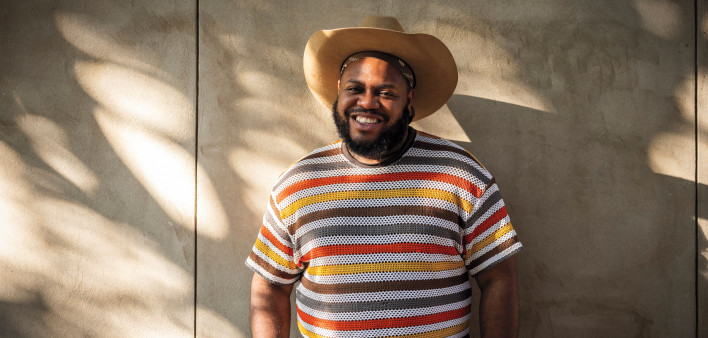
Joe Anderson Jr., 38, always combines health and wellness information and advocacy for his community of gay Black men with fun. “Just doing tabling at health fairs is boring,” he says, so he peppers his outreach efforts with elements of pop culture. For example, in the early 2010s, he organized a regular meetup for Black queer folks in central Texas called Sweet Tea. Not only would they address serious concerns, like what to do if a sex partner disclosed that they were HIV positive, but they’d also discuss, in his words, “who was the best diva for Black gays.”
“And when someone said Celine Dion,” he continues, “we all got silent and just looked at him.” Then he laughs.
After that, Anderson worked for two years for Austin’s health department, where he created the HOPE (HIV Outreach, Prevention and Education) program within the department’s health equity unit, but he didn’t love the job. “I was trying to be innovative, but the department was so rigid.”
A much better fit for him came in 2019, when he arrived at his current workplace, the LGBTQ-specializing Kind Clinic, where he is now the director of community engagement. There, he finds ways to connect folks to HIV testing, treatment and the HIV-prevention regimen PrEP (pre-exposure prophylaxis) in ways that aren’t just “eat your vegetables” but are also spicy, shady and fun. For example, a few years ago, Anderson, who is a huge fan of the Black gay 2000s TV series Noah’s Arc, organized a Juneteenth showing of Noah’s Arc: The Movie at Austin’s landmark Paramount Theatre that turned out to be the centerpiece for an entire Black queer art weekend, including a ball and an after-party.
“I raised $17,000 for this event in a matter of a week,” Anderson says proudly, “and we offered HIV testing in exchange for free tickets.”
So given his love of sexual health advocacy for the gay Black community, Anderson realized he’d be a perfect fit for a program at NMAC (formerly the National Minority AIDS Coalition), a longtime national HIV advocacy group for people of color—especially Black and Latino folks—who have been disproportionately affected by the AIDS epidemic. He was excited when NMAC announced the launch of its Gay Men of Color (GMoC) Fellowship, which seeks to equip motivated same-gender-loving men of color nationwide with the tools needed for impactful community outreach and advocacy on both the national and local level. The group’s purpose, according to its mission statement, “is to make sure the HIV movement is led by the people most affected.”
“We have to create spaces where people feel comfortable."
Although HIV rates among gay white men have plunged in the past decade thanks to high uptake of PrEP, new HIV cases among Black and Latino men have stubbornly flatlined or even ticked up slightly. That, experts say, is due largely to insufficient adoption of PrEP among those groups for various reasons, including unequal access to the regimen, the difficulty of prioritizing it amid cultural stigma, health care provider mistrust, an underinformed sense of personal risk and more pressing burdens, like underemployment and lack of affordable care. Many experts believe that the HIV epidemic in the United States will not end until rates drop dramatically in those groups.
NMAC’s GMoC Fellowship is led by Damián Cabrera, NMAC’s program manager for the treatment division, which includes another group Cabrera oversees, HIV 50+ Strong and Healthy, aimed at older folks living with HIV, many of whom are long-term survivors. Cabrera says his NMAC boss, Moisés Agosto-Rosario, a longtime treatment advocate living with HIV, started the fellowship in 2020, just before COVID-19 hit.
Together, says Cabrera, “we looked at the HIV field and saw there was a lack of spaces specifically for and by GMoC.” COVID upended an array of in-person events that GMoC fellows had planned for its launch, such as having the inaugural fellows make visits to clinical settings, so the program shifted largely to online social media campaigns that were, in Cabrera’s words, “super sex-positive and pleasure--centered and not very clinical.” The campaigns particularly focused on helping people find access to free or low-cost PrEP in their own communities.
In its first year, the program took on 20 fellows, who convened in a series of workshops and webinars and were encouraged to apply for $3,000 mini-grants that could be used to fund fun sexual health events in their own areas. Some fellows tied their work to preexisting food banks in their localities.
After a few years, Agosto-Rosario and Cabrera decided to pair more seasoned advocate mentors of color with newbies to provide one-on-one support and wisdom. One mentor, for example, helped a newbie set up a telework network to help people with HIV connect to services. Other mentees who display an interest in policy—both analyzing best health practices and urging local, state and federal officials to adopt them—are paired with mentors with extensive experience in that field.
Cabrera says he’s also proud of a report that GMoC fellows produced that identified a lack of knowledge about long-term injectable PrEP (which eliminates the need for a once-daily pill) in Black and Latino communities.
“We found there just wasn’t a lot of knowledge or awareness about it,” he says, “and those who did know were concerned about safety and efficacy.” Cabrera says the report gave rise to virtual sessions to get more information out to gay male communities of color, because, says Cabrera, “we have to do better to make sure that people have all the information they need to make their own best choice.”
Direct advocacy, or, put more bluntly, lobbying—is also a skill the GMoC program aims to pass from seasoned vets to newcomers. At this year’s AIDSWatch summit in Washington, DC, where people living with HIV nationwide gather to make Capitol Hill visits to lobby for continued or increased funding for HIV programs, the GMoC program provided attending fellows with a policy training workshop, including skills such as how to deliver an effective message on Capitol Hill. “In fact, by the time they got to the Hill, they’d already practiced their elevator pitches,” says Cabrera.
Of course, under the current White House and Congress, which have severely cut U.S. health programs and funding streams both globally and domestically, the folks in GMoC know they are not operating in an ideal political climate for either LGBTQ or minority health.
At AIDSWatch, those in GMoC “discussed our grief at seeing all this work that generations before us have done just vanishing before our eyes,” says Cabrera. “A lot of our fellows have day jobs with community-based health organizations that have been directly impacted by these federal funding cuts, with some folks even losing their jobs.”
Which helps explain why, according to Cabrera, some of GMoC’s work has shifted to “maximizing the resources we still have at this moment.” He says GMoC fellows are of special value right now because gay men of color in their respective communities “are asking them questions and looking to them to reaffirm that even if we are not in the best scenario at the moment, things are going to work out.”
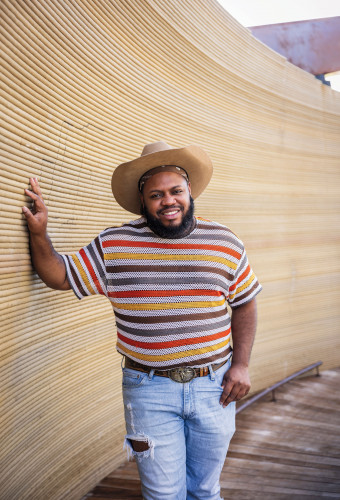
Joe Anderson Jr.Jessica Attie
As for Anderson, he says he’s glad to have a national network of gay health advocates of color to tap into because it expands and enhances the work he does locally in his job for the Kind Clinic. Although he thinks that the GMoC program could benefit from a bit more staffing and funding, he says, “I’ve still formed lifelong friendships through it.”
It’s also given him opportunities to, for example, present at the United States Conference on HIV/AIDS special workshops on doxyPEP, the relatively new, study-confirmed practice of taking the antibiotic doxycycline after sex to dramatically decrease one’s risk of chlamydia and syphilis and modestly reduce one’s gonorrhea risk.
Also, he says, he and another member of GMoC’s advocacy subgroup were able to attend a PrEP in Black America summit in New Orleans in 2023. And he loves being a mentor to newer GMoC fellows, with whom he says he’ll talk about everything from improving PrEP access for Black youth to “What do you want to wear to the Beyoncé concert?”
Yet Anderson admits he has also found the current political climate, with various modes of access to PrEP under threat from the administration, demoralizing. “Every day, we hear about another attack against us. Talking about giving people access to HIV meds, PrEP or doxyPEP, he says, goes out the window when people don’t have access to health care, housing or food,” which further cuts by the administration could only exacerbate.
He adds, “You have an entire administration that hates your identity. I grew up when you didn’t talk about being queer, and then it became OK, and now it feels like they want us back in the closet again.”
Anderson admits he doesn’t have all the answers when it comes to addressing this political moment. “But I’ve decided to not get bogged down in the day-to-day mess of this administration,” he says, “and instead dive deeper into the needs of my community, holding events and programming that center us and bringing in resources that are free or low cost.”
And that, he insists, offers its own rewards, regardless of the political climate. After his Noah’s Arc event, he says, “someone who was there told me, ‘As a Black queer person, I feel like I walk around holding my breath, and at your event, I actually felt like I could breathe.’” That, says Anderson, gave him great joy to hear. “So I just continue to do what I do in the way that I can.”
And if you’re still wondering how all these fun events relate to the ABCs of health and wellness for queer men of color, Anderson insists that such folks need to feel they’re in a safe space if they’re really going to embrace taking steps to safeguard their health. “When I’m in Black spaces that are not queer, I encounter homophobia, but when I’m in queer spaces that don’t acknowledge race, that’s also unsettling.” He mentions that he’s been called “Shaniqua” in white-heavy bars for wearing a do-rag. He also says he’s had older white gay men squeeze his privates to assess their size or assume he’s a drug dealer in such venues.
“We have to create spaces where people feel comfortable, where you can bring your full self with a level of trust,” he declares. And GMoC, he says, has been a valuable venue in which he and his fellow queers of color can do just that.
To learn more about NMAC’s GMoC program, go to nmac.org/programs/treatment/gmoc or send an email to Damián Cabrera at dcabrera@nmac.org.
Comments
Comments