

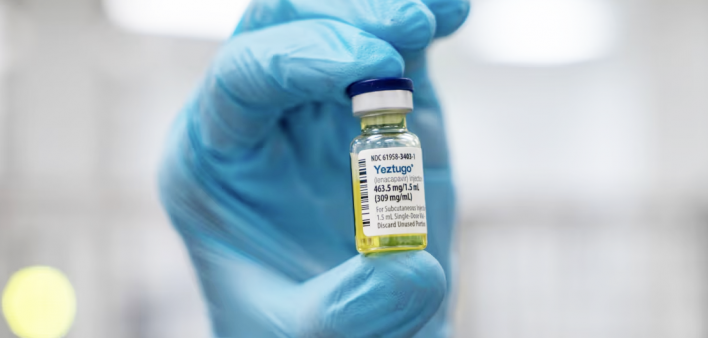
The U.S. State Department announced that it will partner with drugmaker Gilead Sciences and the U.S. President’s Emergency Plan for AIDS Relief (PEPFAR) to deliver the HIV prevention drug lenacapavir, given as a shot every six months, to low-income countries, Reuters reported.
Gilead will offer the long-acting HIV pre-exposure prophylaxis (PrEP)—sold in the United States as Yeztugo—to the Global Fund and PEPFAR without profit to low-income countries. This partnership allows for generic manufacturers to seek regulatory approvals for lenacapavir for PrEP and provide access in sufficient volumes to meet demand and generate competition to drive down costs.
The collaboration will allow up to 2 million people over three years in countries supported by both organizations to access lenacapavir for PrEP.
“The support of the U.S. State Department through PEPFAR will accelerate access to lenacapavir and move us closer to ending the HIV epidemic,” said chairman and CEO of Gilead Sciences, Daniel O’Day, in a news release. “Lenacapavir is one of the most important scientific breakthroughs of our time and the result of nearly two decades of work by Gilead scientists. We are providing the medicine at no profit in this partnership so we can support the U.S. government in delivering lifesaving programs where the need is most urgent.”
PEPFAR is the largest commitment by any country to address a single disease. Since it established PEPFAR in 2003, the U.S. government has invested over $110 billion in the global HIV response. It has saved 26 million lives and prevented millions of HIV cases in more than 50 countries. PEPFAR’s future, however, remains uncertain, as the Trump administration attempts to defund and dismantle it (more on this below).
PrEP refers to medication used by an HIV-negative person to reduce the risk of contracting HIV. To date, the Food and Drug Administration has approved four forms of PrEP: Truvada and Descovy are daily pills; Apretude is a shot given every two months; and Yeztugo is a twice-yearly injectable. Due to insufficient evidence, Descovy is not yet indicated as PrEP for cisgender women and trans men. Generic (and much cheaper) versions of Truvada are available. To learn more about PrEP, see the POZ Basics on HIV Prevention: Pre-Exposure Prophylaxis (PrEP).
Lenacapavir was approved under the brand name Sunlenca in 2022 to treat certain people with HIV. It is the first capsid inhibitor. As such, the medication is not a vaccine that trains the immune system to fight the virus, but because all traditional HIV vaccine candidates have to date failed in large trials, long-acting PrEP is a powerful tool in the prevention toolbox.
Based on impressive data from the Phase III PURPOSE 1 and PURPOSE 2 studies, Yeztugo was approved as HIV PrEP this summer. Yeztugo can be a good option for teens and young adults, who often struggle with consistent adherence to daily prevention pills.
Results from PURPOSE 1 showed that lenacapavir was 100% effective for young cisgender women in South Africa and Uganda. The injections significantly reduced HIV incidence compared with the background incidence rate and were superior to daily Truvada pills.
Last week, CVS Health announced it will not add lenacapavir to its commercial plans despite its proven effectiveness. Yeztugo is priced at $28,000 yearly (or $14,000 per shot), and Gilead is still negotiating with CVS Health, Reuters reports.
“Accelerating access to innovations like lenacapavir is imperative if we are to turn the tide against HIV,” said Global Fund executive director Peter Sands in the release. “In a severely resource-constrained environment, we must ensure that breakthrough tools are deployed rapidly, affordably and in the most impactful way possible. By targeting where lenacapavir can have the greatest effect, and working with the U.S. and Gilead, we can help countries integrate it efficiently into their HIV prevention programs—reducing new infections and enabling them to move more quickly along the pathway toward transition and self-reliance.”
On the first day of his second term, President Donald Trump signed an executive order that banned any new government spending on foreign aid projects, including PEPFAR. Stopping its funding has interrupted lifesaving HIV treatment for those who relied on the program. HIV activists have been protesting government funding cuts ever since.
Earlier this month, HIV advocates held a sit-in on the streets outside the Office of Management and Budget and near the White House to protest “billions in unlawfully withheld funds” for PEPFAR.
Additionally, nearly 100 advocates rallied on Capitol Hill last week to protest pending cuts to HIV prevention, services and research in the United States and worldwide. Displaying quilt panels submitted by organizations from across the country, the activists called on legislators to save—and expand—HIV funding.
“Every single dollar that they are threatening to cut from HIV funding isn’t just a number on a spreadsheet. It’s someone’s medication, it’s someone’s housing, it’s someone’s health care and lifeline,” said Marnina Miller, co–executive director of the Positive Women’s Network. “We will not go back to the days of funerals every week. We will not go back to silence and HIV stigma. We will not go back to a time when our communities had to fight just to be seen as full humans. We will not go back to politicians ignoring our pain while our people died. We will not go back to those days.”
To read more, click #Lenacapavir or #Federal Funding. There, you’ll see headlines such as “Yeztugo PrEP Works Well for Young People,” “USCHA Day One: Scenes From the 2025 U.S. Conference on HIV/AIDS” and “Changes at NIH Give Political Appointees Greater Power to Fund or Block Research.”


Comments
Comments